
Why Service Teams and Parts Teams Stay Disconnected in Industrial Distribution

Why Service Teams and Parts Teams Stay Disconnected in Industrial Distribution
 admin
admin
It’s 8:47 AM on a Tuesday.
A technician walks to the parts counter with a work order in hand. The part he needs isn’t on the shelf. The parts team says it’s on backorder — but nobody told the service scheduler, who already promised the customer a same-day turnaround.
The clock is ticking. The customer is calling. And two departments that are supposed to be working toward the same goal are, once again, operating in complete isolation.
Sound familiar?
In industrial distribution, no two departments are more dependent on each other — yet more consistently out of sync — than Service and Parts. Each team works hard within their own lane. But the gap between those lanes is exactly where profits quietly erode: delayed repairs, broken customer promises, idle technicians, and mounting frustration on both sides of the counter.
Here’s the Truth: This Isn’t a People Problem. It’s a Structural one.
Disconnected teams in industrial distribution don’t just slow things down — they cost real money. And in the service-to-parts workflow, the breakdown happens dozens of times a day.
This post breaks down exactly why that disconnect exists, what it’s actually costing your dealership, and — more importantly — what you can do to close the gap for good.
The Service-Parts Relationship: Built to Collaborate, Wired to Conflict
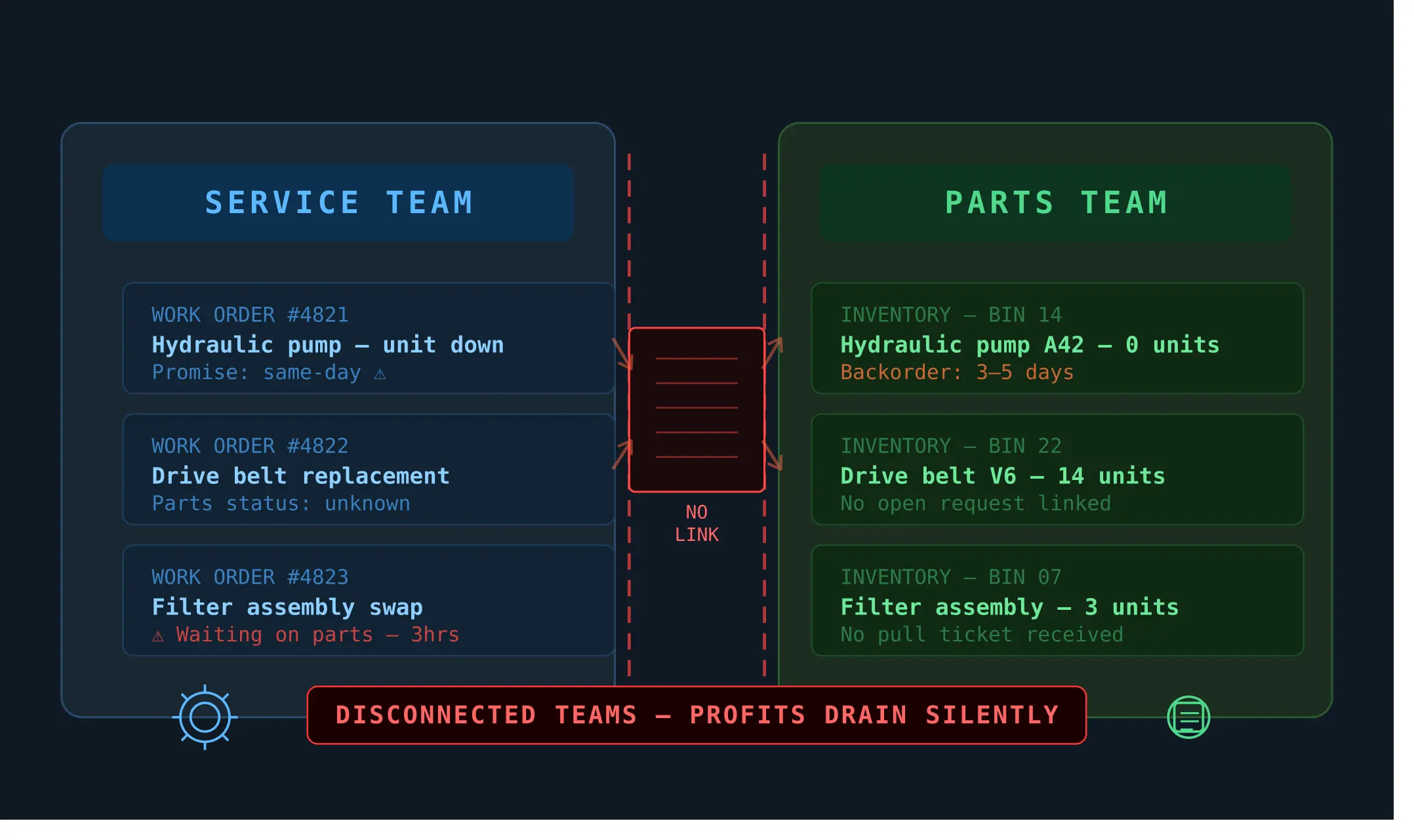
Before fixing anything, it helps to understand why this problem is so persistent. Service and Parts aren’t just two departments that happen to sit near each other. They are deeply interdependent — and yet, the way most dealerships are structured, they’re set up to operate independently.
Two Departments, One Goal — But Separate Worlds
Both teams ultimately serve the same customer. But the way they measure success looks nothing alike.
| Department | Key Performance Metrics |
|---|---|
| Service | Labor hours billed, first-time fix rate, technician utilization, RO cycle time |
| Parts | Fill rate, inventory turns, gross profit on parts sales, backorder rate |
These scorecards rarely overlap — and that’s the first structural fault line. When each team is optimizing for their own numbers, cross-department coordination becomes secondary. It’s not intentional. It’s just how the incentives are wired.
The Daily Flashpoints That Reveal the Disconnect
Most dealer principals don’t see the full picture of how often this friction plays out. Here’s what it looks like on the floor, every single day:
- A technician walks up mid-job to find the part he needs isn’t in stock — service bay stalls
- Parts orders a high-volume item that service never confirmed they’d use — dead stock accumulates
- A service advisor quotes a turnaround time without checking parts lead time — customer promise is broken
- A work order is written, but the parts team doesn’t see it until they’re already behind
- An emergency parts pull happens without a formal request — inventory shrinks, accuracy suffers
- Neither team has visibility into which repair orders are open, what’s waiting on parts, or what’s been fulfilled
These aren’t rare exceptions. They are the daily operational friction that adds up to weekly revenue loss and long-term customer attrition.
The Root Causes Behind Disconnected Teams in Industrial Distribution
Understanding why this happens is the first step to addressing it. There are five root causes that show up consistently across dealerships and distributors of every size.
1. Separate Systems That Don’t Talk to Each Other
Most dealers run different software platforms for their dealer management system (DMS), parts inventory, and service scheduling. These tools were often purchased at different times, from different vendors, and were never designed to share data with each other.
When a repair order is opened in the service system, the parts team may not see it until someone physically walks over or picks up the phone. Research from Forbes found that 81% of organizations say data siloing is preventing them from achieving their operational objectives — and industrial dealerships are no exception.
The downstream effect is predictable: an industrial parts distributor promises stock based on what their system shows, only to find the part isn’t actually there when the technician needs it. The service scheduler gets blindsided. The customer gets delayed.
2. Incompatible KPIs That Create Departmental Tunnel Vision
Parts managers are incentivized to keep inventory lean — minimize carrying costs, reduce dead stock, improve inventory turns. That’s smart inventory management.
But service needs parts available right now, staged before a job starts, ready to go the moment a technician opens a work order.
This is a structural tension that no amount of goodwill can fully resolve. What counts as a win for the Parts department — lean inventory — can be a direct loss for the Service department — a stockout on a critical job. Without shared performance metrics, each team will keep optimizing for their own scoreboard, not for the customer sitting in the waiting area.
3. No Formal Communication Cadence Between Teams
In most dealerships, there is no standing meeting between the Parts Manager and the Service Manager. Communication happens reactively. Service schedules jobs without looping in parts. Parts orders stock without confirming what service actually has on the board. Both teams get blindsided — often at the worst possible moment.
As one industry voice put it plainly: “Parts and service managers don’t always get along. When they don’t, the whole team suffers.”
But even when the relationship is good, without a formal, recurring communication structure, critical information falls through the cracks every day.
4. Cultural Silos Reinforced Over Time
This one is harder to see on a spreadsheet but very real on the floor. Departments develop their own culture, language, and in some cases, their own internal politics. Long-tenured employees build habits around how things have always worked. Cross-departmental transparency can feel threatening to teams that have operated autonomously for years.
There’s also a technology history problem here. Platforms built for parts management, service scheduling, and DMS were never originally designed to be interoperable. According to PTC, software developers historically focused on innovating single-department features rather than building systems that could contribute to enterprise-wide data sharing. The silos were, in many ways, baked into the software itself.
5. No Real-Time Visibility Across Work Order Status
At the core of most disconnects is a simple, solvable problem: neither team can see what the other is doing in real time.
Without a live, shared dashboard showing every open repair order, what parts are needed, what’s been pulled, what’s on backorder, and what’s at risk of missing a customer promise — coordination depends entirely on manual check-ins. Phone calls, walk-ups, whiteboards, sticky notes. All highly error-prone. All time-consuming. All unnecessary with the right system in place.
Why Disconnected Teams Cost Dealers More Than They Think
Most dealers feel this pain as “operational frustration.” The real cost, though, is measurable — and it’s significant.
Lost Technician Productivity
A technician waiting on parts is a technician not billing hours. That gap has a real dollar value.
If a technician’s fully loaded wage is $35 per hour, just 10 non-billable hours per week equals $350 in lost gross margin — per technician. Scale that across a shop of eight technicians:
$350 × 8 techs × 52 weeks = $145,600 in annual margin erosion from parts delays alone.
Industry benchmarks set the bar at 90% parts availability within four hours of final diagnosis. Most disconnected shops aren’t close to hitting that number.
First-Time Fix Rate Failures
When parts aren’t staged ahead of a job, technicians improvise, make substitutions, or reschedule — all of which drag down first-time fix rates. High-performing dealerships hold a first-time fix rate between 85% and 95%. Shops running on disconnected operations consistently fall below that range.
Every callback costs extra labor, takes a bay out of rotation, and puts the customer relationship at risk. It’s not just an efficiency problem — it’s a reputation problem.
Customer Defection and Fixed-Ops Revenue Leakage
Fixed operations — service and parts combined — now represent 13.2% of total dealership revenue, up from 12.4% in 2023. For many industrial dealers, fixed ops is the revenue engine that offsets shrinking margins on equipment sales. Losing customers from that channel isn’t a minor issue.
Research from Cox Automotive found that 45% of vehicle and equipment owners report dissatisfaction with their service experience, with poor communication as the single biggest complaint. Customers who leave over service reliability don’t just take one job with them — they take the entire lifetime value of their account.
The Hidden Costs Nobody Tallies
Beyond the obvious numbers, there’s a layer of costs that rarely appear on any report:
| Hidden Cost | Impact |
|---|---|
| Emergency parts procurement | Up to 40% price premium over standard ordering |
| Overtime labor to recover delayed jobs | 1.5–2x normal labor rates |
| Inventory shrinkage from undocumented parts pulls | Accuracy loss, financial exposure |
| Missed warranty claim windows | Direct revenue loss, OEM compliance risk |
| Reactive scheduling chaos | Increased technician turnover, morale decline |
These hidden costs typically exceed the visible, direct costs by a factor of two to three. They don’t show up cleanly on a P&L — which is exactly why they keep happening.
What Alignment Actually Looks Like — Practical Models for Industrial Dealers
Closing the gap between Service and Parts isn’t about team-building retreats or new hiring. It’s an operational architecture decision. Here’s what it looks like in practice.
1. Shared Dashboards and Real-Time Work Order Visibility
Both teams need to see — from one screen — every open repair order, what parts are required, the status of each part (in stock / pulled / on order / backordered), and the estimated ready time.
Modern, purpose-built dealer ERP platforms bring service, parts, sales, accounting, and reporting into a single operational timeline. When a customer changes a ship date, when inventory is short, or when a shipment is delayed, the right system triggers workflow actions across both teams automatically — no phone calls required.
Practical tip: If your current DMS doesn’t surface parts-pull status to service advisors in real time, that’s your number one integration gap to close.
2. A Formal Daily Standup Between Parts and Service Managers
This costs nothing and pays back immediately. A 15-minute morning sync between the Parts Manager and Service Manager should cover:
- What jobs are on the schedule today, and what parts are needed?
- What’s been pulled and staged — and what hasn’t?
- Are there backordered items that will affect customer promise times?
- Any emergency orders that need immediate escalation?
This single daily habit eliminates most of the reactive chaos that defines disconnected operations. It turns reactive firefighting into proactive planning.
3. Standardized Digital Parts Request Workflows
Replace verbal requests — the single biggest source of miscommunication in any shop — with structured digital pull tickets tied directly to the work order.
When a parts request is digital and linked to an RO, the parts team receives everything they need: the RO number, the technician’s name, the job description, the part number, and the urgency level. The “I thought you meant the other filter” conversation goes away. So do the undocumented emergency pulls that quietly drain inventory accuracy.
4. Unified KPIs That Hold Both Teams Accountable Together
Introduce fixed-ops metrics that both the Parts Manager and Service Manager are measured on — not separately:
| Shared KPI | What It Measures |
|---|---|
| Same-day parts fill rate for open ROs | How often parts are available when service needs them |
| Average time from RO open to parts pull complete | Speed of the handoff between departments |
| First-time fix rate | Quality of the combined service + parts workflow |
| RO cycle time | End-to-end efficiency of the repair process |
| Technician billable hours as % of available hours | True productivity, accounting for parts wait time |
When both managers are accountable to the same outcomes, they stop optimizing against each other and start working toward the same goal.
5. Integration-First Technology Decisions
The market is moving fast here. API-based integration suites — like the one Aurora Parts and Procede Software unveiled at the 2025 Aurora Dealer Conference — are designed specifically to eliminate the manual handoff between parts management and repair operations. Fleet-approved estimates automatically import as repair orders. Inventory data syncs in real time. Stock recommendations update based on historical sales and live RO activity.
Purpose-built dealer platforms reduce the need for workarounds entirely. If your current stack requires a phone call or a walk-up to transfer information between service and parts, that’s not a workflow problem — it’s a technology gap.
A Real-World Look at What Changes When Teams Connect
Consider a mid-size Midwest industrial equipment dealer — 12 service technicians, a parts counter handling 200-plus SKUs daily, and two managers communicating primarily by text message and whiteboard.
Before Alignment:
- Average RO cycle time: 4.2 days
- First-time fix rate: 71%
- Technician idle time waiting on parts: 2.3 hours per tech per day
- Same-day parts fill rate: 61%
What Changed:
- Implemented a shared DMS module connecting repair orders directly to the parts request queue
- Introduced a 10-minute morning standup between both department managers
- Standardized digital pull tickets tied to every work order
- Created a shared fixed-ops dashboard reviewed weekly by both managers and the dealer principal
After Alignment:
- RO cycle time dropped to 2.8 days
- First-time fix rate improved to 88%
- Technician idle time cut to under 45 minutes per day
- Same-day parts fill rate improved to 84%
The technology created the infrastructure. But the daily communication discipline was the real driver of change. Systems enable alignment — they don’t create it on their own.
Is Your Dealership Running Disconnected? A Quick Self-Check
Run through this checklist. If you check three or more, your service-parts gap is already costing you.
- Technicians regularly walk to the parts counter mid-job for parts they didn’t know were missing
- Parts orders are placed without confirming what service has scheduled for the week
- Customer promise times are set without a real-time parts availability check
- Service advisors have no visibility into which ROs are currently waiting on parts
- There is no regular standing meeting between Parts and Service management
- “I didn’t know you needed that” is a phrase you hear at least once a week
- Emergency buys and rush freight are routine, not the exception
- Inventory shows parts as “in stock” that aren’t findable when pulled
- Technician hours billed per day consistently fall below available hours
If you checked three or more: the gap is real, it’s costing you money today, and the fixes are within reach.
The Fix Is Closer Than You Think
Here’s the bottom line. Disconnected teams in service and parts aren’t an unavoidable fact of life in industrial distribution. They are a structural problem — and structural problems have structural solutions.
The disconnect has clear roots: separate systems, misaligned performance metrics, no formal communication routines, and technology that was never built with cross-department collaboration in mind. The cost is real, recurring, and measurable — in idle technician hours, emergency parts premiums, first-time fix failures, and customers who quietly walk away.
But dealers who take the time to close that gap — with shared visibility tools, a daily communication habit, unified KPIs, and integration-first technology decisions — see meaningful, lasting improvements in efficiency, profitability, and customer retention.
Your Service team and your Parts team want the same thing: a smooth operation and customers who come back. The wall between their workflows isn’t inevitable. It’s fixable. And in most dealerships, the first steps cost very little and pay back fast.
Ready to Close the Gap?
If you’re ready to connect your service and parts teams with a platform built for industrial dealers, mail us to Schedule a Demo: info@turqosoft.com
Or tell us: Which of these disconnects is costing your dealership the most right now? Drop a comment below or reach out to our team for a free fixed-ops assessment.
Alternatively, you can also follow us on LinkedIn, or YouTube, for interesting updates on digital transformation for your business.