
ERPNext for Food Manufacturing in Vietnam: Fixing Hidden Profit Leaks in Inventory, Batch & Production
ERPNext for Food Manufacturing in Vietnam: Fixing Hidden Profit Leaks in Inventory, Batch & Production
 admin
admin
Food manufacturers in Vietnam are not losing money because of weak sales.
They are losing it quietly — through expiry, yield loss, and inventory confusion.
Across the country, especially in seafood processing, agro-based industries, and packaged foods, businesses operate across multiple locations — factories, cold storage units, and export hubs. At the same time, they deal with tight margins and strict quality expectations from global buyers.
Yet, the real problem often goes unnoticed:
- Stock exists, but teams cannot locate it
- Expired batches remain in storage
- Production output does not match raw material consumption
These are not isolated issues. They are system-level gaps.
This is where ERPNext for food manufacturing in Vietnam becomes relevant — not just as software, but as a way to bring control across inventory, batch tracking, and production.
Let’s break down where the losses actually happen.
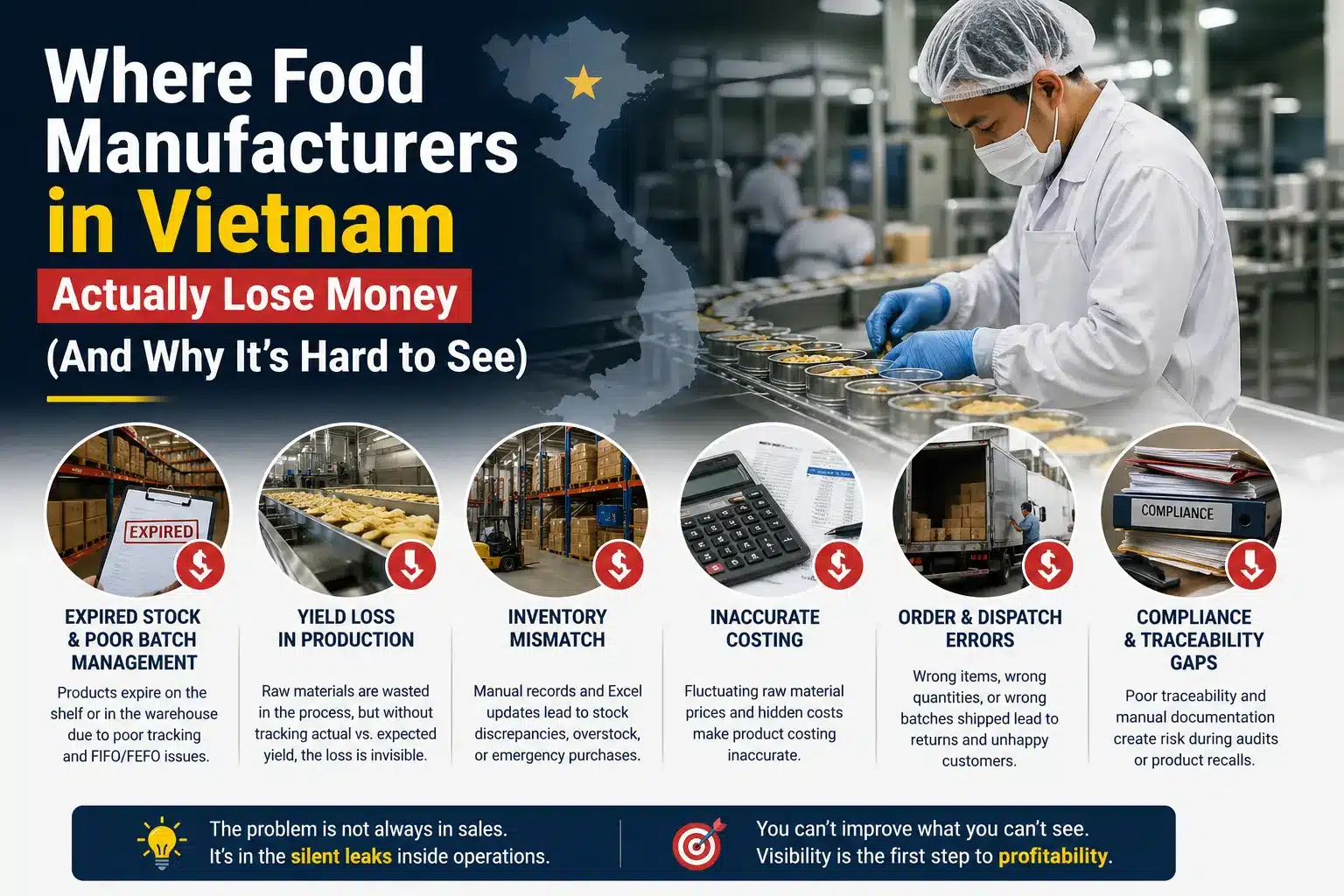
Where Food Manufacturers in Vietnam Actually Lose Money (And Why It’s Hard to See)
1. Inventory Chaos Across Locations
Most food manufacturers in Vietnam operate across:
- Processing units
- Cold storage facilities
- Distribution warehouses
However, inventory tracking is often handled through Excel, phone calls, or messaging apps.
What this leads to:
- Overstock in one warehouse and shortage in another
- Delays in fulfilling export orders
- Cash locked in unused inventory
Without real-time visibility, inventory becomes a guessing game instead of a controlled asset.
2. Batch & Expiry Mismanagement
Batch control is critical in food manufacturing. But many companies still rely on FIFO instead of a proper FEFO inventory system.
Common gaps:
- No batch-level tracking
- Expiry dates not actively monitored
- Wrong batches dispatched
For export-focused industries like seafood, this creates serious risks.
You can refer to global food safety practices from organizations like Food and Agriculture Organization, which emphasize traceability and expiry control in food supply chains.
What this leads to:
- Sudden write-offs
- Shipment rejections
- Loss of buyer trust
Batch control is not optional. It directly affects revenue and compliance.
3. Production & Yield Leakage
Many manufacturers track production output, but not the difference between expected and actual yield.
Losses happen due to:
- Moisture changes
- Spillage
- Overuse of raw materials
But since these are not tracked properly, they remain invisible.
Hard truth:
If you are not tracking yield per batch, your margin is only an estimate.
Yield loss is one of the biggest hidden profit leaks in food manufacturing.
4. No Trust in Reports
Data is often scattered across:
- Excel sheets
- Accounting tools
- Manual logs
As a result:
- Inventory does not match sales
- Financial reports do not match operations
- Decision-making becomes slow and uncertain
When reports don’t match, leaders stop trusting the system — and start relying on assumptions.
5. Dispatch Errors & Customer Complaints
Manual picking processes create errors such as:
- Wrong items shipped
- Incorrect quantities
- Wrong batch selection
This leads to:
- Returns
- Credit notes
- Customer dissatisfaction
Dispatch errors are not just operational issues. They directly affect brand reputation.
6. Weak Costing & Margin Visibility
Most businesses do not have real-time product costing.
Why?
- BOM costs are not updated
- Raw material price changes are not reflected
- Production losses are not included
Result:
- Selling at incorrect margins
- No clarity on profitable products
If you don’t know your actual cost, you don’t know your real profit.
7. Compliance & Traceability Gaps
Vietnam’s food export sector requires strong traceability.
However, many businesses struggle to answer:
- Which raw material batch went into which finished product?
- Which customer received that batch?
What this leads to:
- Audit stress
- Risk during product recalls
Traceability is not just for compliance. It is essential for risk control.
Why Traditional Systems Fail Food Manufacturers
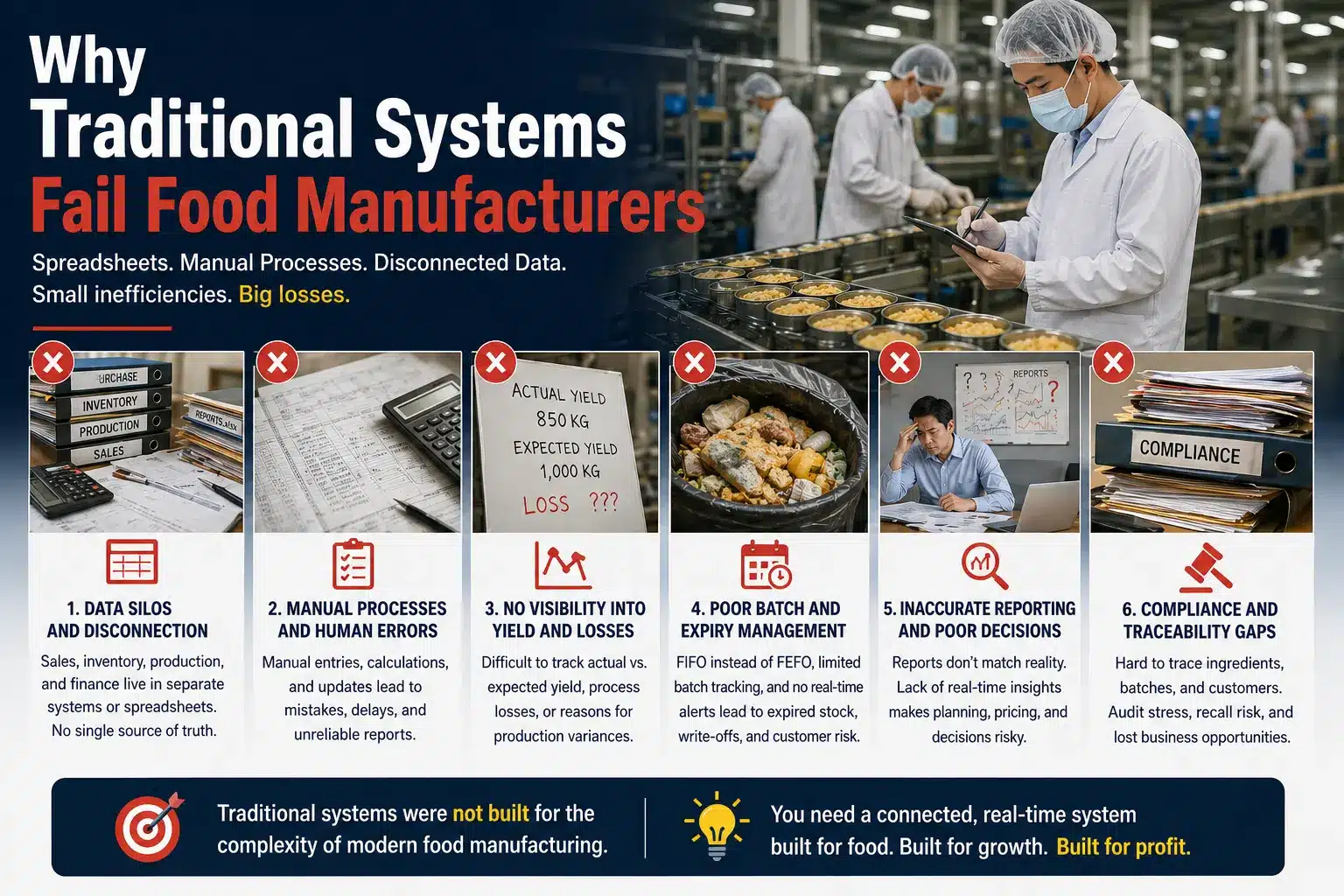
Excel Was Never Built for This Scale
Excel works for small operations. But as businesses grow:
- Data becomes outdated quickly
- Errors increase
- There is no control over processes
Local Software Creates Data Silos
Many companies use separate systems for:
- Inventory
- Sales
- Accounting
These systems do not talk to each other.
Result:
- Duplicate data
- Mismatched reports
- Operational delays
Enterprise ERPs Are Too Heavy
Large systems like SAP ERP and Oracle NetSuite are often considered.
But for mid-sized manufacturers in Vietnam, they come with challenges:
| Factor | Enterprise ERP | Practical ERP (ERPNext) |
|---|---|---|
| Cost | High | Moderate |
| Implementation Time | 6–18 months | 6–12 weeks |
| Flexibility | Limited | High |
| Complexity | High | Manageable |
Many businesses don’t fail because they lack ERP. They fail because they choose systems that don’t fit their operations.
What Changes When You Implement ERPNext for Food Manufacturing in Vietnam
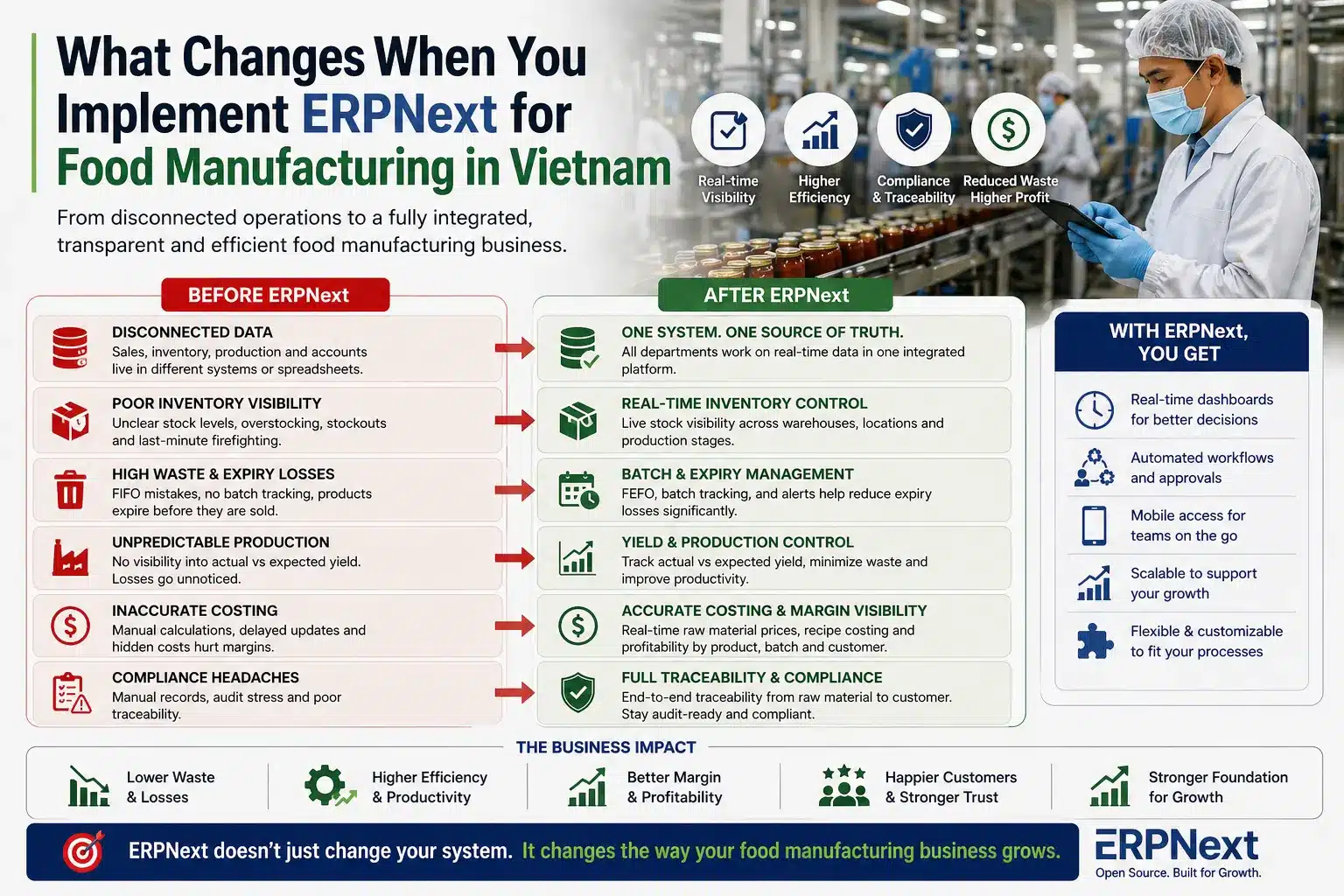
1. Real-Time Multi-Location Inventory Visibility
- View stock across all warehouses in one dashboard
- Track transfers between locations
- Eliminate “ghost stock”
2. FEFO-Based Batch & Expiry Control
- Automatic batch selection based on expiry
- Alerts for nearing expiry
- Reduced waste
3. Batch-Wise Production & Yield Tracking
- Compare planned vs actual output
- Identify losses per batch
- Improve production efficiency
4. Controlled Dispatch & Picking
- System-generated picking lists
- Batch selection rules
- Reduced dispatch errors
5. Real-Time Costing & Margin Visibility
- BOM linked to purchase prices
- Accurate product costing
- Clear profit margins
6. End-to-End Traceability
Track every step:
- Raw material → production batch → finished goods → customer
This makes audits and recalls faster and easier.
7. One System, One Version of Truth
- Inventory, sales, and accounting in one system
- Reliable reports
- Faster decision-making
ERPNext turns disconnected operations into a controlled system.
Real-World Use Case: Food Manufacturer & Exporter
Before ERPNext:
- Inventory mismatch across cold storage
- Shipment rejections due to batch issues
- No clarity on margins
After ERPNext implementation:
- Full batch traceability
- Correct FEFO dispatch
- Yield tracking per production batch
Result:
- Reduced export rejection
- Improved margins
- Faster audit process
Is ERPNext the Right Fit for Your Food Manufacturing Business?
Best Fit For:
- Multi-location operations
- Businesses dealing with batch and expiry
- Export-oriented companies
Not Ideal For:
- Very small operations
- Single-location businesses with simple workflows
Conclusion
The Real Problem Isn’t Sales — It’s Operational Leakage
Food manufacturers don’t lose money in marketing.
They lose it in:
- Expiry
- Yield loss
- Inventory confusion
ERPNext does not just manage processes. It gives visibility and control over these problem areas.
If your business is facing:
- Inventory mismatch
- Batch confusion
- Shrinking margins
Then the issue is not your team.
It is your system.
Write to us info@turqosoft.com and book a focused demo to map your current workflow and identify where losses are happening — and how to fix them.
You can also follow us on LinkedIn, or YouTube, for interesting updates on digital transformation for your business.


Comment (1)
Leif
Thanks for sharing this useful information.