
ERP Software Kerala: How Local Businesses Are Choosing the Right System in 2026
ERP Software Kerala: How Local Businesses Are Choosing the Right System in 2026
 admin
admin
Search “ERP software Kerala” and you’ll get the same result most business owners get: forty open tabs, a dozen companies each claiming to be the “#1 ERP provider,” and no real answer to the question you actually asked. Which one fits your business, and how much will it cost you?
This guide skips the sales language. It covers what ERP software actually does, what it really costs in Kerala right now, how to match a system to your industry, and how to tell a good implementation partner from a vendor who just wants a signature on a contract.
If you run a manufacturing unit, a food business, a solar EPC company, a distribution firm, or a cooperative institution in Kerala, this is written for you.
Why Kerala Businesses Are Suddenly Talking About ERP
Kerala’s business environment has shifted faster than most owners have had time to plan for. Three pressures are pushing companies toward ERP software at the same time:
GST and compliance have made spreadsheets unreliable. Filing returns, reconciling input credit, and tracking TDS across multiple branches is hard to do accurately by hand once a business crosses a certain size. One missed entry can mean a notice, a penalty, or a blocked credit.
The state is actively pushing digitization. Kerala’s Open Network for Digital Commerce (ONDC) rollout and updated MSME policy are both aimed at getting small and mid-sized businesses onto digital systems, so they can access wider markets and qualify for support schemes that increasingly assume digital record-keeping.
Operational pain has simply built up. These are the searches business owners actually run before they type “ERP software Kerala”:
- “Why does my stock count never match what’s in the system”
- “GST filing errors every month, need better accounting software”
- “No visibility into what’s happening at other branches”
- “Manual payroll taking three days every month”
If any of those sound familiar, the problem isn’t effort. It’s that spreadsheets, WhatsApp groups, and individual memory were never built to run a growing business.
ERP isn’t a trend businesses are chasing for its own sake. It’s a response to compliance pressure, state-level digitization, and operational strain that’s already showing up in daily work.
What ERP Software Actually Does
Strip away the marketing, and ERP software is one thing: a single system that holds your inventory, accounting, HR, sales, and project data in one place instead of scattered across five tools and someone’s notebook.
Core modules, in plain terms:
| Module | What it replaces |
|---|---|
| Inventory & stock | Manual stock registers, guesswork on reorder timing |
| Accounting & GST | Excel sheets, separate tally entries, manual reconciliation |
| HR & payroll | Attendance registers, manual salary calculation |
| CRM & sales | Notebooks, personal phone contacts, missed follow-ups |
| Project & production tracking | WhatsApp updates, verbal status checks |
What changes operationally:
Before ERP, a typical Kerala SME runs on parallel systems that don’t talk to each other. Stock is tracked in a register. Accounts are done separately at month-end. Sales orders live in someone’s head or a notebook. When that person is on leave, the business slows down.
After ERP, one entry updates everything connected to it. A sales order automatically checks stock, updates inventory once dispatched, and feeds the accounting module. Nobody has to remember to update three different places.
ERP isn’t about adding complexity. It’s about removing the manual coordination that’s currently eating your time and causing errors.
If you’re evaluating different ERP platforms, our detailed guide ERPNext vs SAP vs Zoho: Which ERP Actually Fits a Growing Indian SME? explains where each solution performs best.
The Real Cost of ERP in Kerala: SAP B1 vs Open-Source (ERPNext)
This is the part most vendor websites avoid because the numbers aren’t flattering to the software they’re selling. Here’s an honest breakdown.
SAP Business One has been the default recommendation from many Kerala resellers for years, largely because it’s a recognizable brand. But the pricing structure works against small and mid-sized businesses:
- Per-user licensing that compounds as you add staff, reportedly around ₹7,500 per user per month or a comparable one-time fee per user
- Annual maintenance charges layered on top of licensing, typically 15–22% of the license cost
- For a small business with up to five users, total first-year cost commonly falls in the ₹8–12 lakh range, and it climbs steeply from there as headcount grows
ERPNext, an open-source ERP built on the Frappe framework, works differently. There’s no per-seat license fee at all. What you pay for is implementation: the work of configuring the system around your chart of accounts, GST setup, production process, and approval chains.
- No licensing cost, since the software itself is free and open-source
- Implementation typically runs ₹75,000 to ₹5 lakh depending on business size and complexity
- Annual maintenance contracts (AMC) commonly range from ₹30,000 to ₹1.2 lakh per year
- Adding new employees doesn’t add a new recurring license fee, unlike per-seat platforms
Side-by-side comparison for a 10–25 user Kerala business:
| Cost factor | SAP Business One | ERPNext (open-source) |
|---|---|---|
| Software license | Per-user, recurring | ₹0 (open-source) |
| Typical Year 1 cost | ₹14–75 lakh+ | ₹1.5–3.5 lakh |
| Cost of adding new users | Increases every time | No added license cost |
| Annual maintenance | 15–22% of license cost | ₹30,000–1,20,000/year flat |
| Customization | Possible, often costly | Native, part of implementation |
The gap here isn’t marginal. For most Kerala SMEs and mid-sized manufacturers, ERPNext-based ERP costs a fraction of what SAP B1 requires over a five-year period, without giving up core functionality most businesses actually use.
Before you sign anything, ask for a full first-year cost and a five-year projected cost, not just the implementation quote. That single question separates transparent vendors from ones hoping you won’t ask.
ERP Comparison at a Glance
Not every ERP is built for every business. The best choice depends on your company size, industry, budget, and long-term growth plans.
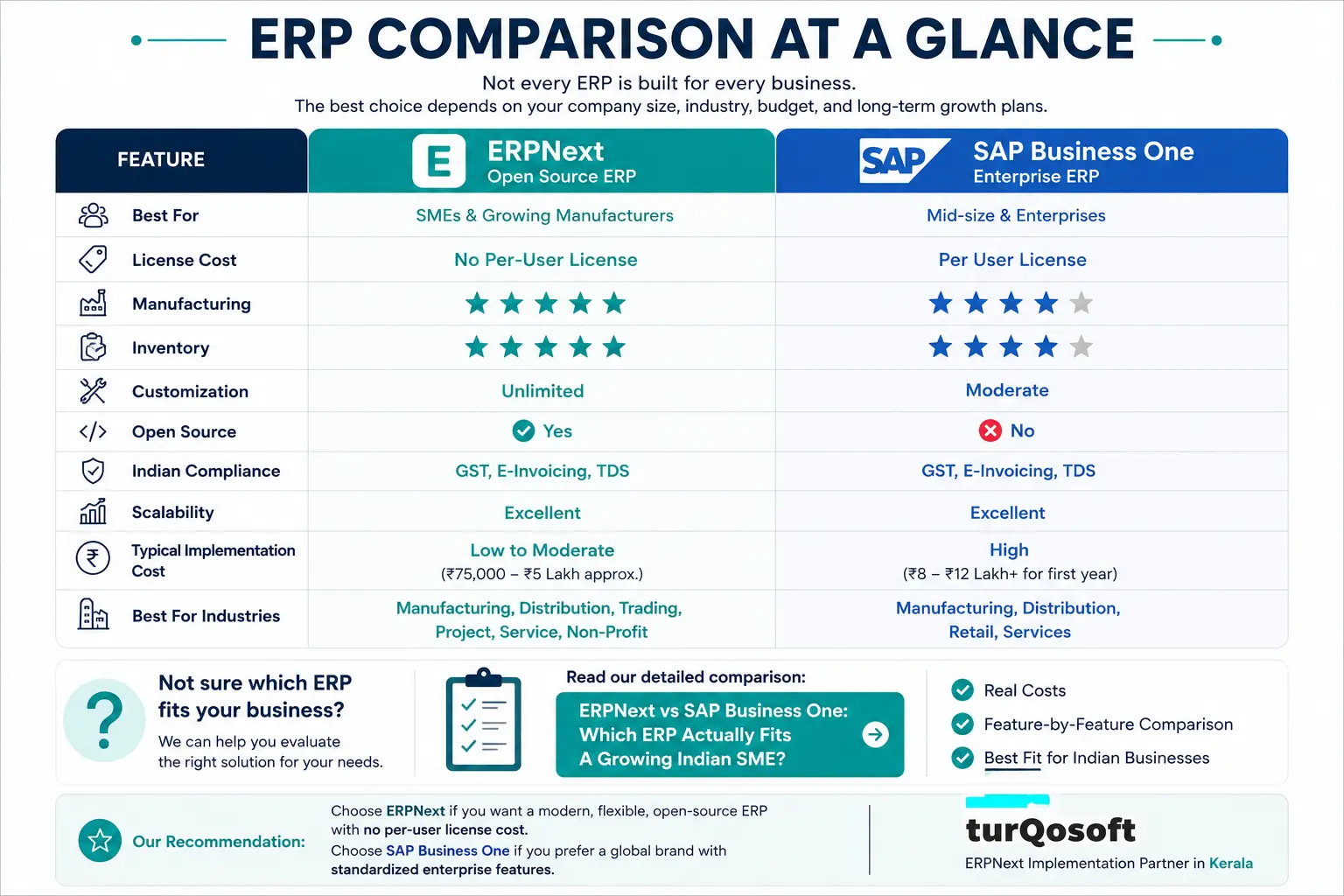
Some businesses also require industry-specific workflows beyond standard ERP features. Learn when ERPNext Custom App Development becomes the right investment.
Industry-Specific ERP Needs in Kerala
Generic ERP advice misses the point that a quarry, a solar EPC firm, and a food distributor need genuinely different things from their system.
| Industry | Common pain point | What ERP should solve |
|---|---|---|
| Manufacturing | No visibility into production stages, material wastage | Bill of Materials (BOM) tracking, shop floor status, production planning |
| Solar & EPC | Project costs spiral past budget, approvals stuck in email | Project-based costing, structured approval workflows (for example, tracking equipment or subsidy approvals stage by stage) |
| Food & cold storage | Stock spoils before it’s used, batch issues untraceable | Batch and expiry tracking, shrinkage reporting |
| Mining, quarrying & distribution | Stock spread across sites, no single view | Multi-location inventory, logistics tracking |
| Cooperatives & government-linked bodies | Audit requirements, compliance-grade hosting | Detailed audit trails, hosting that meets government data standards |
If a vendor gives you the same pitch regardless of your industry, that’s worth noticing. Your production process, your compliance obligations, and your data sensitivity should shape the ERP setup, not the other way around.
How to Choose an ERP Partner in Kerala (Not Just Software)
The software matters less than who implements it. A well-chosen ERP badly implemented will fail. A modest ERP well implemented will work for years.
Why local experience matters more than brand recognition:
A partner who has actually implemented ERP for a Kerala quarry, a Kochi manufacturer, or a cooperative federation understands local compliance quirks, regional supplier patterns, and the kind of staff training that works here. A partner who’s only worked with businesses in another state is starting from zero on all of that.
What certification actually tells you:
A Frappe-certified or SAP-certified partner has been vetted by the platform owner on implementation standards. It doesn’t guarantee a good experience, but it does mean there’s a baseline of accountability if something goes wrong.
Red flags to watch for:
- A vendor quotes a price before asking detailed questions about your process
- No clear answer on what happens after go-live (support plan, AMC terms, response time)
- Reluctance to share client references in your own industry
- Pressure to sign quickly, with no time for you to compare
Five questions to ask before signing:
- Have you implemented this for a business in my industry before? Can I speak to that client?
- What’s included in the AMC, and what counts as a chargeable extra?
- Who owns my data if I ever want to switch partners later?
- What does your training plan for my staff actually look like, week by week?
- What’s your average response time for a support ticket after go-live?
Vet the partner as carefully as the software. The implementation is where most ERP projects succeed or quietly fail.
Why Turqosoft for ERP Implementation in Kerala
Turqosoft is a Frappe-certified implementation partner based in Kerala, with teams at Infopark, Kochi and Technopark, Trivandrum. That local presence means implementation, training, and support happen with people who understand the state’s business environment directly, not through a call center in another city.
The team has implemented ERPNext across a genuinely varied set of industries: manufacturing, solar, food, mining and quarrying, and distribution, along with work for cooperative and government-linked clients, where hosting and compliance requirements are stricter than a typical private business.
What implementation with Turqosoft looks like in practice:
- Process scoping before any configuration begins, so the system is built around how your business actually runs
- Data migration handled carefully, since a botched migration is one of the most common causes of ERP failure
- Staff training that continues past go-live, not a single session before launch
- AMC support with a clear response structure, and hosting options
If you’re currently comparing quotes or trying to figure out whether ERPNext fits your specific industry, a conversation costs nothing and gives you a clearer picture than another vendor brochure would.
A Kerala-based, industry-experienced, certified partner reduces the risk that sits in every ERP decision. That risk reduction is worth more than a slightly lower quote from a vendor who’s never worked in your sector.
Common ERP Implementation Mistakes Kerala Businesses Make
Even with the right software and a decent partner, projects go wrong in predictable ways.
Choosing on price alone. The cheapest quote often excludes post-implementation support, meaning the real cost shows up six months in, when something breaks and there’s no one to call.
Skipping proper process mapping. Businesses that jump straight to configuration without documenting how work actually flows end up with a system that fights their process instead of supporting it.
Underestimating training. Staff who don’t understand the new system revert to old habits, spreadsheets included, within weeks. Training needs to be planned, not squeezed in as an afterthought.
Most ERP failures aren’t software failures. They’re planning failures. Slowing down at the scoping and training stages saves far more time than it costs.
Choosing the Right ERP Partner in Kerala
ERP software in Kerala isn’t a decision you make by picking whichever result shows up first in search. It comes down to three things: understanding what your business actually needs, knowing the real cost so you’re not surprised later, and choosing a partner who has done this work in your industry before.
If you’re a manufacturing, solar, food, distribution, mining, or cooperative-sector business in Kerala trying to move past spreadsheets and disconnected systems, Turqosoft can walk you through what implementation would actually look like for your specific setup, with clear numbers, not guesswork.
Talk to Turqosoft for a free ERP consultation built around your industry. Reach out for a process audit, and get a straight answer on what ERP would cost and take for your business, before you commit to anything.